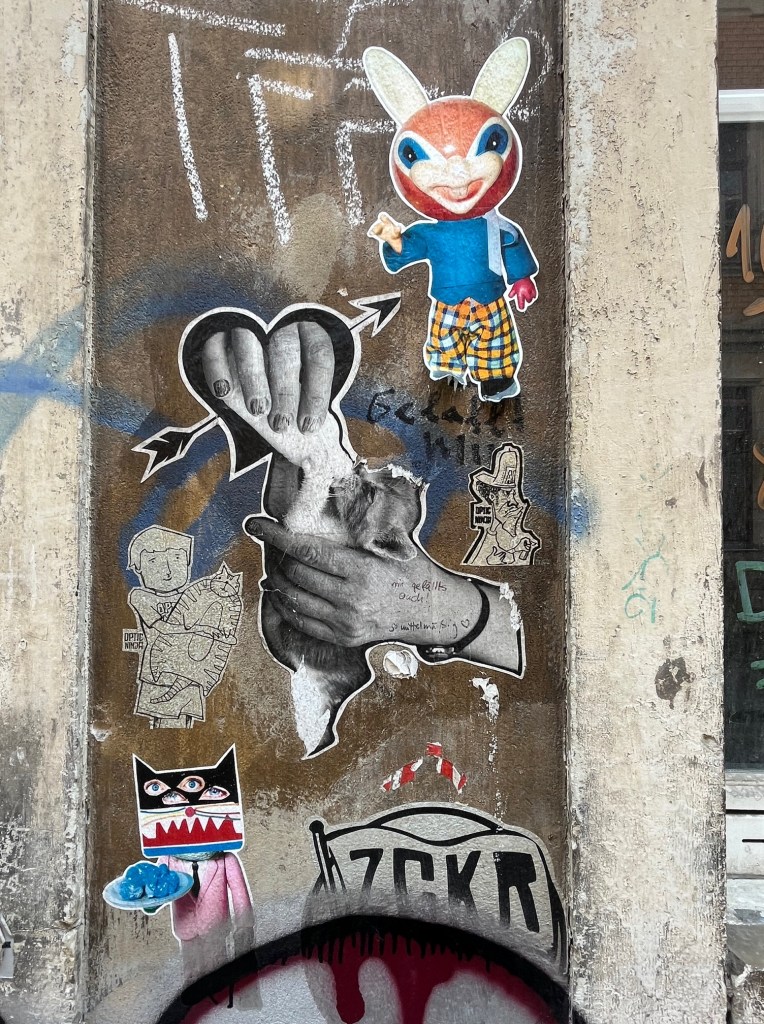
Neurodivergence is increasingly mobilised to support ethico-political agendas related to animal politics. This blog post proposes new concepts to identify these growing trends and position ourselves in these important new debates.
It has become a commonplace that neurodivergent people – particularly autistics – experience unique forms of proximity with nonhuman animals. This affinity, which is often positioned along gendered lines, tends to naturalise and essentialise autistic people (including autistic women), who are portrayed as pure and innocent beings closer to animals by nature, in virtue of their neurology.
We have learned from feminist movements that declaring your love doesn’t make you innocent, extreme forms of violence being routinely committed in the name of love. Autistic people may be closer to animals than most allistics, but what tells us that this love does not harm its beneficiary? The example of Temple Grandin (2006) is particularly enlightening: the livestock engineer has devoted her life and career to developing more ‘humane’ ways of slaughtering animals. Note that her unique autistic traits and affinity for animals have been the main reasons behind Grandin’s status as a representative of autistics and animals.
More recently, I came across a curious justification of anti-animal violence grounded in neurodivergent traits. In Neurodivergent, by Nature, Joe Harkness (2025) introduces us to his fascination with insects and his practice of a curious hobby: entomology. Harkness is quick to anticipate his readers’ horror at the graphic description of his practice. Hoping to reassure them, he disclaims that this seemingly weird hobby is actually humane.
Like Grandin, Harkness mobilises and implicitly weaponises neurodivergence – represented here by the weirdness or quirkiness of his special interest – against animalist and antispeciesist sentiments. His story provides a perfect example of what I call neurodivergent speciesism, namely, a rhetorical or ideological position which uses neurodivergence as a motive, excuse, or justification for anti-animal violence.
In a range of situations, the ethics and politics involved in the relationship between neurodivergent humans and nonhuman animals are not so easy to arbitrate: animal-assisted therapy, food diets, etc. My aim with the concept of neurodivergent speciesism is not to eschew the complexities brought forth by neurodivergent perspectives, nor to reiterate the pervasive ableism of vegan and antispeciesist movements. Rather, the concept signals a worrying trend of using a naturalistic and essentialistic understanding of neurodivergence – recall the title of Harkness’s book – to morally justify speciesist practice.
I will skip over how Harkness’s book also exemplifies the profound tensions that oppose ecological and antispeciesist/animalist ideals and how the former are often weaponised against the latter. My interest here lies in offering a counter-approach to neurodivergent speciesism through what I call neurodivergent veganism and neurodivergent antispeciesism.
By neurodivergent veganism, I designate the unique ways of supporting, engaging with, or practising veganism from a neurodivergent perspective. While veganism is often adopted from a place of ethical or political commitment, it is likely that neurodivergent people commit to a vegan lifestyle or antispeciesist politics for unique reasons. Think of the black-and-white thinking and sense of justice that autistic people (alongside other neurodivergent communities) have become famous for. While this neurodivergent feature is often portrayed in rather naturalising, oversimplified, and depoliticising ways, it is nonetheless a lived experience many of us can attest to.
There also exist many barriers to a vegan lifestyle in neurodivergent communities: ARFID and other eating disorders, difficulties with newness, executive functioning, motricity, or sticking to routines. Similarly, neurodivergent and disabled people may struggle to participate in political gatherings and street activism due to financial precariousness, sensory matters, and struggles with social interactions with neurotypicals. Instead, many neurodivergent people – particularly autistics – may prefer to engage in online or small-scale forms of activism.
When these challenges and preferences are acknowledged within vegan movements, it is often to invalidate them: it is suggested that neurodivergent and disabled people are not truly committed to antispeciesism and that their anti-ableist demands weaken the movement. There is something profoundly neuronormative in the way neurodivergents are cast as enemies to animal liberation, as if only neurotypical forms of antispeciesist activism were valid and valuable.
For what seems like a minority of neurodivergent people, these challenges may indeed mean that a vegan lifestyle – understood as a strict plant-based diet and a boycott of all animal-based products and entertainment – is not sustainable. That said, the definition proposed by the Vegan Society (n. d.) recognises ‘veganism [as] a philosophy and way of living which seeks to exclude—as far as is possible and practicable—all forms of exploitation of, and cruelty to, animals’. Could this mean that marginal consumption of animal-based products, when done by neurodivergent individuals and in the least unethical ways possible, especially when coupled with active participation in antispeciesist activism, belongs in veganism as a movement?
Moreover, even those neurodivergent people who may not be able to commit to a vegan lifestyle – whether temporarily or more durably – may still contribute to the production and dissemination of vegan and antispeciesist ideals from their own standpoints. Should their ways of practising neurodivergent antispeciesism be negated all the same?
Whatever the answer to this question may be, it is not clear that the challenges experienced by neurodivergent people should invalidate veganism as a moral principle and political horizon. On the contrary, they evidence the steps we should take to ensure the unrestrained participation of neurodivergent people in animalist and antispeciesist movements. More importantly, could it be that the way neurodivergent people adopt veganism – when they do – echoes their unique ways of being, feeling, and connecting with others and with the world? If that is true, and I believe it is, then it appears that animalist movements have much to learn from neurodivergent people and the ways we conceptualise and engage in veganism and antispeciesism.
References
Temple Grandin and Catherine Johnson, Animals in Translation: Using the Mysteries of Autism to Decode Animal Behavior, New York: Scribner, 2005.
Joe Harkness, Neurodivergent, by Nature: Why Biodiversity Needs Neurodiversity, London and Dublin: Bloomsbury, 2025.
The Vegan Society, ‘Definition of Veganism’, no date, accessed 21 October 2025. https://www.vegansociety.com/go-vegan/definition-veganism.
This blog entry is inspired by a chapter of my doctoral thesis to be defended in 2026.


Leave a comment